
Northern Lights Forecast in Iceland: How to Read and Use It
A good aurora forecast helps you know when the lights might appear, where your chances are highest, and how to avoid the most common mistake: showing up on a cloudy night.
In this guide, you’ll learn exactly how to read the Northern Lights Iceland forecast, how to use the main tools like KP index and cloud maps, and how to plan your evening like a pro. Whether you’re traveling along the south coast, staying in Reykjavík, or exploring Iceland’s north, this article gives you everything you need to maximize your chances of witnessing the aurora.
What Is the Aurora and How It Works (Explained Simply)
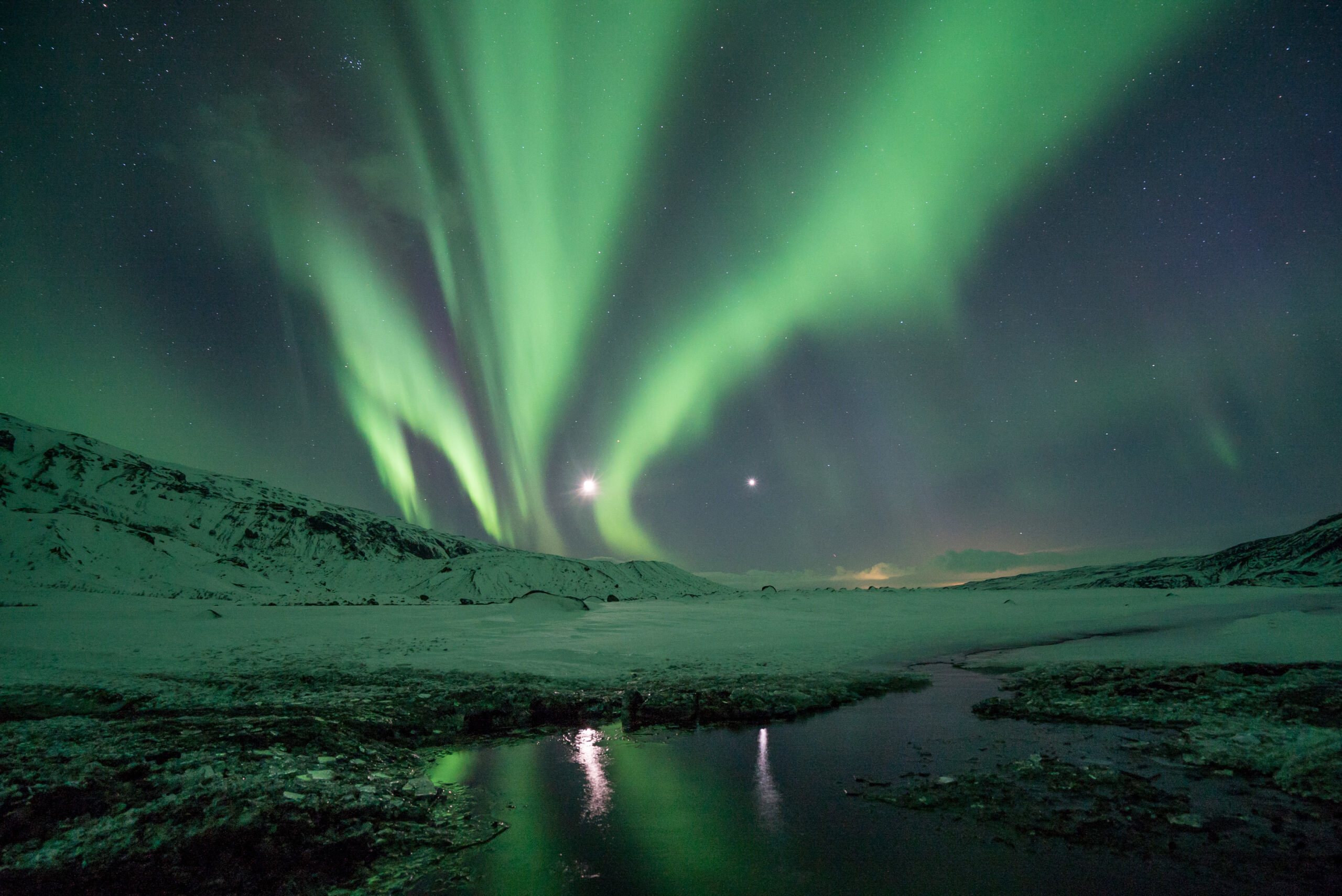
The Northern Lights—also known as the aurora borealis—happen when charged particles from the sun collide with the Earth’s atmosphere. This creates green, pink, purple, and even red dancing lights in the sky.
You don’t need a perfect scientific explanation to enjoy the aurora, but here are the basics you should remember:
- The sun sends out bursts of energy.
- When these particles reach Earth, they follow magnetic fields toward the poles.
- As they enter the atmosphere, they light up the sky.
The stronger the solar activity, the stronger the aurora. But even low-level activity can produce visible lights in Iceland—if the sky is dark and clear. That’s why learning how to read the forecast matters more than anything else.
KP Index – What It Means and What Numbers to Look For
The KP index is a global scale that measures geomagnetic activity. It ranges from 0 to 9:
- KP 0–1 → Weak. Low chance, visible mostly with cameras.
- KP 2–3 → Moderate. Good chance almost anywhere dark.
- KP 4–5 → Strong. Good show, visible widely.
- KP 6+ → Storm-level. Rare geomagnetic storms.
In many countries you need a high KP index to see the aurora. Iceland is different. Thanks to its high latitude, you can often see auroras with:
Important:
A high KP index doesn’t matter if the sky is covered in clouds. That’s why Icelanders pay more attention to cloud cover than KP numbers.
Cloud Cover – The Most Important Part of the Northern Lights Forecast
In Iceland, cloud cover is the true key to seeing the Northern Lights.
You could have a very strong aurora (KP 5 or higher), but if the sky is cloudy, you won’t see anything. The Icelandic weather office provides a detailed cloud map showing:
- Low clouds
- Mid-level clouds
- High clouds
Green areas mean clouds, and white areas mean clear skies. Always look for white patches at your location or nearby, especially where the wind direction might push the clouds away.
How to read the Iceland cloud map correctly:
- Look at your location (Reykjavík, Vík, Akureyri, etc.).
- Look for pockets of clear sky nearby.
- Notice wind direction—clouds move fast in Iceland.
- Compare with aurora activity like KP index.
- Choose the clearest sky within your driving range.
Clouds often clear in unexpected places, especially inland valleys or coastal gaps. This is why even on a “cloudy night,” locals still go out—because Icelandic weather changes fast.
Best Websites and Apps for Real-Time Forecasts
Here are the main tools Icelanders use daily:
1. Vedur.is (Icelandic Meteorological Office)
The most reliable and most used site. It shows:
- Cloud cover map
- Aurora activity
- Wind and temperature
It’s the official forecast used by tour companies, guides, and locals. Use Vedur.is for cloud cover in Iceland and combine it with any KP app you prefer. That’s the winning formula.
2. Aurora Forecast (App)
Great for quick checks:
- KP index
- Probability percentage
- Solar activity alerts
Not Iceland-specific, but useful for travelers.
3. Hello Aurora
For those who love to share and help the community.
- Share and check real-time Northern Lights.
- Photos and alerts.
- Map to check if it is close to you.
Excellent to not miss any good aurora.
How to Use the Northern Lights Forecast Tonight (Step-by-Step)
Here is a simple and practical guide you can use every night of your trip:
Step 1: Check the Cloud Map
Go to Vedur.is and look at cloud cover first.
- Find your location on the map.
- Search for the nearest white (clear) area.
Step 2: Check the Aurora Activity
You can use:
- Vedur’s aurora forecast
- Aurora Forecast app
- Space Weather Live
Look at:
- KP index
- Solar wind speed
General activity level
Even low KP is enough in Iceland if the sky is clear.
Step 3: Choose Your Spot
Pick a place with:
- Clear sky
- Darkness (away from street lights)
- A good northern horizon (mountains can block the view)
Step 4: Give Yourself Time
Auroras come in waves. Sometimes they appear for 2 minutes, disappear for 20, then come back stronger.
Plan to stay out at least one hour.
Step 5: Be Patient and Enjoy the Night
Many travelers give up early. The most incredible shows often happen:
- After midnight
- When the forecast looks “low”
- When skies momentarily open
Locals know: if the sky clears, the aurora often shows up.
A Subtle Note About Tours (Optional but Helpful)
If the forecast looks complicated or you don’t want to drive at night, a guided northern lights tour is a great option. Local guides know where the skies tend to open and follow the real-time forecast throughout the night. However, tours cannot guarantee auroras—they simply improve your chances.
Final Tips and Summary
The northern lights forecast is the most important tool you have when aurora hunting in Iceland. While many travelers focus only on the KP index, the real secret lies in reading cloud cover, watching conditions shift, and being flexible with your plans.
Remember these key points:
- KP 1 or 2 is often enough in Iceland.
- Clear sky matters more than high KP.
- Vedur.is is the most accurate cloud map for the country.
- Stay out at least one hour—auroras come in waves.
- Be patient, move a little if needed, and follow the clear sky pockets.
Whether you’re watching from Reykjavík, exploring the south coast, or traveling across north Iceland, the aurora will reward those who understand the forecast and know how to use it.
With the right tools, a little knowledge, and some patience, you’ll give yourself the best possible chance to experience one of the world’s most breathtaking natural wonders.
More from our blog